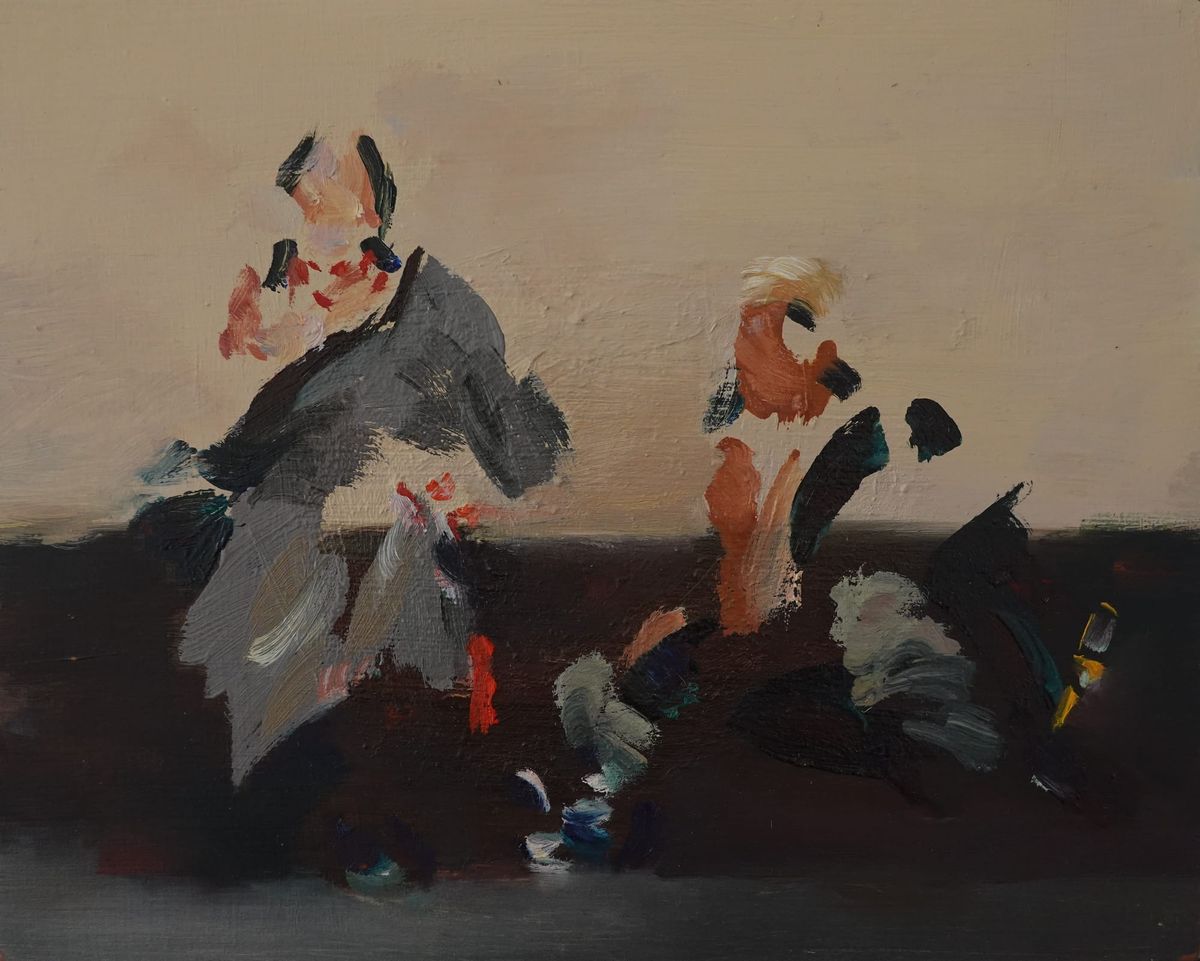
My father had a sobriquet that captured the overflowing pathos he expressed in his life: the Weary Father. Pathos is more apparent in some cultures than others, as seen in the Korean concept of han or the Greek tragedy as a narrative form. Even if pathos is not a commonly nourished condition in the contemporary Chinese language, I feel that it is of spiritual significance to my father’s creative practice. For Shen Daohong, it was not content that guided his practice of form, but pathos rather that endowed his form with feeling. The impact of his work was thus produced by this emotional form and content. His approach to traditional Chinese painting can be said to be in the same lineage as Xu Beihong, Lin Fengmian, Wu Guanzhong, and their ilk, known for combining Chinese ink with Western aesthetic traditions. In terms of content, my father explored subjects similar to those of Dong Xiwen, Chen Danqing, and other artists concerned with the notion of borderlands. I’d like to consider the reflection of pathos in his creative practice as coming from the perspective of an individual in search of belonging.
My father liked to describe himself as an old tree stump when talking about his relationship with me, but this metaphor didn’t address how the stump had been formed to begin with. For example, what did the stump lose or gain in the process of becoming itself? Where did its roots lie? When I first heard this metaphor, it struck me that absolutely no consideration was given to the nature of the stump itself. The stump simply existed in relation to me. Due to the influence of their own forefathers, people of my father’s generation not only considered their roots a trifling matter, but preferred to forget about them entirely. In matters of culture and identity, my father’s generation could be said to exhibit a state of rootlessness. My father sustained a spirit of self-sacrifice in his life and did not identify with any needs of his own, except when he was working. I believe that this tendency to sacrifice made it painful for him to confront himself and his relationships. When asked about his needs, he always said he had none, creating a distance which often weakened the potentiality of his connections to others. But through his work, he expressed what he was still willing to voice. I often wonder what my father had known about his needs in his life and work, what needs may have remained unknown. As someone from a generation with limited knowledge of his own family history, a generation that history is unable to value, how did his sense of belonging influence his own creations? What was this unknown road that he had opened unto himself, and where did it lead?
Shen Daohong’s gaze upon the borderlands in his art offers some concrete clues. The figure of the unknown Other is not totally unknowable; it simply cannot be understood through known methods. Perhaps this comes from a place of respect and dignity. His paintings attempted to utilize an updated relationship between aesthetic and technique, portraying culture as a kind of harvest to form a new frame of mind. But is this new frame something that our senses can touch? I describe Shen Daohong’s portrayal of culture as a harvest because he often engaged in collage in his practice. Adorning his figures in appropriate clothes, suspending space within a specific structure or against a natural background, he formed a shapeless shape through collage. Did he choose to portray a person in order to concretize them as an individual? Or was the completed portrait merely a vessel for the individual, just as an outlined background contains the setting therein, instead of serving as an attestation that a certain person existed at a certain time? The subjects of these paintings do not belong to the past, present, nor future. Rather, they create a vacuum of history and temporality. My father proactively traveled within to Sichuan to learn about the cultural expressions of ethnic minorities and the process by which their identities had been replaced by or merged with that of consumers. His work did not endeavor to restore their testimony via realism, but consciously omitted it. Could it be that his brush and ink inherited the meaninglessness of old-fashioned traditions? Like a kind of practical uselessness, he transformed significance once more into meaninglessness through his continued exploration of new forms. The inner conflict of belonging did not manifest as diametric opposition, but rather became extended via content and form. Through his work, my father’s own sense of belonging gradually became nearly negligible. Is what became negligible the known part of him or the unknown? What is unknown is often confirmed by its own emptiness. Emptiness gives meaning to absence, transforming lack into something that can be felt. Shen Daohong’s work certainly does not lack this form of emptiness.
Whether form is the focus of the relationship between Shen Daohong and the figures he portrays is not a question that can be answered directly, in my opinion. This is in spite of the fact that he previously expressed and emphasised the satisfaction one may feel when a painting is lifelike. When I first started studying art with my father, I understood that a grasp of form was a paramount and yet also most easily executable skill in his view, something he considered a natural-born talent. My father certainly never lacked any talent for outlining form, and his practice reflected the shift in focus throughout his works. Form is not simply about shapes, and lifelike resemblance is not premised upon appearance alone. His expression of form was essentially a pursuit of the superlative. His manner of depicting musculature or constructing a face and body conveyed his extreme sensitivity to form, as well as the pursuit of a particular essence through this painstaking attention to detail. This pursuit of the superlative in form came across in his realist paintings, regardless of the medium, often tightly bound to the subject matter and connected to the constraints of freedom of a historical dimension. Ink is a mode of expression that has the capacity to self-disintegrate on a material level. Using a method that expresses process to capture the inner essence of an image is like borrowing the knowledge of a school of salmon swimming upstream. But any mode of expression, including ink, will bear a new system that is completely apart from the work once the work’s symbolism has taken shape. This is a system created and accepted by the collective of practitioners. I understand that Shen Daohong had a complicated relationship to this system and felt conflicted about it. He believed not only that the restraint of symbolism in ink paintings must be overcome, but a return to individual desire was necessary. Perhaps this act of returning was what allowed him to develop survival mechanisms in facing his personal needs. But he once expressed his hope that he might someday have a stage where he could paint “freehand” in ink to his heart’s content. He was never able to reach that stage. This perhaps confirms the necessity of the survival mechanisms that he had developed, while serving as both an affirmation of and a return to his personal desires.
If shan shui paintings can be considered a technique to open a connection between humans and the natural world, as well as a repository for that network of connections, then the techniques that Shen Daohong valued are the roads which lead to unknown and multiple temporal dimensions. He could not restrain himself and did not wish to portray only quiet elegance. His work arouses a kind of potentiality in facing the identity of the assimilated Other and the rootlessness of the self. Shan shui paintings shrink the position of the human until they are no more than a part of nature. To use ink to paint human figures is often related to the pursuit of virtue. In my father’s shan shui paintings appear specific figures who are connected to him by ideology. The return journey that he pursued was a path through the field of consciousness, guided by his own self-awareness and his view on human relationships and the world around them. He was devoted to the relationship between form and content and depicted human figures through a philosophical engagement, as though casting a sincere vote to return to a reality of lack. Shen Daohong’s paintings created a world that enfolded him because he merged into the subject matter himself. His acts of portraying a formless form and writing an unconscious frame of mind were derived from the sorrow, shared by many, that one knows that one cannot know.
written by: Shen Xin, in October 2021, for the publication "The Wall of Silence – a collection of paintings by Shen Daohong"
translated by: Mike Fu
有关倦父
父亲自有称号为倦父,在生活中的表达充满了悲情性。悲情在一些文化里比另一些显著,如韩国有한(“恨”),希腊有悲剧的形式和叙事体。悲情并非当代中文语言中被普遍滋养的美学,但在我的感知里,它在父亲的实践中也具有重要的精神性。形式在沈道鸿的实践里并没有主导内容,而悲情更像是在赋予了形式情感,通过有感情的形式和创作内容本身产生效应。作为艺术家,他在国画的手法上,可以被理解为是延续了徐悲鸿, 林风眠,吴冠中等人对于中国水墨和西方绘画传统结合的努力。内容上继续探索了董希文,陈丹青等人有关边疆题材的脉络。我想从个体对于归属感的追求,去思考他对于悲情的珍视在实践中的体现。
父亲形容自己和我的关系时常把自己比作老树桩,这个比喻并没有涵盖有关树桩形成的讨论。比如树桩失去了什么,在成为自己时得到了什么,根茎在哪里。这个比喻传达给我时,没有带上对于本体的讨论,仅仅停留在和我的关系的层面。父亲那代人,对于自己的根从他们的父母辈开始便显得不仅不重要,而是和遗忘有关。可以说在文化和身份认同的语境中,父亲那一代呈现出无根的状态。表现在生活中,父亲有着持续的自我牺牲精神,对于自身的需求没有什么认同感,除了在工作中。属于他个体的牺牲倾向,在面对他自己和面对他生命中的关系时,抵达了我认为具有伤害性的地步。当被问到需求,他总是无所求,往往关系的可能性被削弱了。而在作品中的表达,是他愿意发声的坚持。我时常思考,父亲生前,在生活和作品中的已知需求是什么,未知需求是什么?作为对自己家庭历史了解有限的一代,作为历史不能被珍视的一代,他的归属感如何影响了自己的创作?他开拓的对于他而言也同样未知的路是什么?
这虽然是以问题的形式提出的,但沈道鸿创作内容上看向边疆已给出一定的线索。属于看似是“他者”的未知,并非不可知,却是不能通过已知的方式被了解,也许也是出于尊重和珍惜。他的绘画尝试着更新的美学思考和技术的关系,将文化比作物来描述,而形成了新的意境,但此意境是否是感官功能能触及的?之所以形容沈道鸿将文化比作物来描述,是因为他的手法中常包含了拼贴。给人物着上适合的服饰,将空间悬置于特定的建筑或自然背景中,拼贴出了无形之形。他选择去描述个体的肖像是为了确立个体吗?还是说,完成的肖像是人物的容器,正如勾勒出的背景是容器所处的场所,而并非对于“此人处于此时此地”的证实?这些画作内容,不属于过去,当下,或未来,却是确立了一种真空的历史和时间。父亲自主的去目睹了四川境内少数民族在身份上的文化表达,被消费者身份取代的融合方式和过程。在创作中,这样的见证并没有被写实恢复,被沈道鸿有意识忽略的,是否也是笔墨继承旧俗之传统的无意义?正如一种无用之用,他通过不断创造新的形式,将有意再次转换成了无意。有关归属感的矛盾并没有呈现出两级分化,反而在内容和手法上被延续了。关于父亲自身的归属感在创作中渐渐变得微不足道。使之变得微不足道的,是已知的部分,还是未知的部分呢?未知时常被留白所肯定,留白赋予缺席意义,使得缺失变成能够被感知到的事。沈道鸿的创作也并不缺少这样的留白。
形,是否是沈道鸿和被描绘的人物的关系重心,对于我而言不是一个能被直接回答的问题。虽然在言语中,他也强调形似的结果能给到的满足感。最开始和他学习绘画的我,了解到对于形的捕捉在他看来一定是最重要且容易达到的,他将之称为天赋。父亲绝不缺乏所谓勾勒形的天赋,而他的实践内容表达了重点的转移。形不仅仅限于形式,形似也不止于现象,形在他的表达中充斥着对于极致的追求。对于肌肉的描写,和脸部与身体结构的叙事,传达出对于形的极致和极致中透露出的本质的追求。在写实绘画中,无论媒介,追求极致的形,往往和内容紧紧捆绑,往往和历史维度中有关自由的匮乏相连接。水墨是一个在材质上具有自我瓦解能力的表现手法。用一个能表达过程的手法来捕捉形象的本质,似乎是向逆流而上的三文鱼群借来的智慧。但任何表现手法,包括水墨,在渐渐确立属于它的象征性后,也会承载一个从根本上不属于它的新系统,这是一个通过实践者集体默认创造的系统。沈道鸿和这个系统的关系在我的理解中是复杂的,对于这个系统里的矛盾点,他的思考在于不仅仅需要突破水墨象征意义的拘谨,也需要回归到自身的欲望,这样的回归也许是他面对自身需求时,发展出的生存技术的衍生。但他曾说,希望自己能够在某日有尽情挥洒水墨“写意”的阶段,可那个阶段并没有到来,这或许是在肯定被他发展出的生存技术是必要的,也是对于他自身本有的欲望的肯定和归原。
如果山水画是一种技术,将人和自然的世界打通来让关系网络有归处,那沈道鸿所珍惜的技术,便是通向未知和多重时间维度的可行之路。他克制不住,不能止于淡雅,为的便是激发出这样的可能性,面对他者被同化的身份,和自身的无根。山水画将人的位置缩小,仅仅只能成为自然的一部分。水墨作人物画,也常与道德上的追求有关,他的山水是一些特定的人物,他们和他的意识形态有关。他所追求的回归之路,踩着的土地是意识的田野,引路的是意识之下的自我觉知,与视野中人和世界的关系。他对于形式和内容的关系饱有虔诚,人物以哲学式的参与性被他所描述,似是在表决回归有着缺失的现实的诚意。沈道鸿的绘画创造了包裹他的世界,因他自身也被融为主题的一部分。为描绘无形之形,书写无意之意境,是属于他和很多人的“自知不可自知”的悲情。

Member discussion: